Fifteen-plus years of BC mortgage experience, distilled into practical writing on buying, renewing, refinancing, and building wealth through real estate.
Kelowna Ranks First in Canada for Wildfire Risk: What Condo Buyers Need to Check Before Closing
The strata insurance renewal came back 22% higher. Not because of claims, there hadn't been any. Because the building sits 1.8 kilometers from unmanaged forest fuel on the Upper Mission bench.
That's the version of wildfire risk most Kelowna condo buyers don't see until after closing. The rankings matter, but the insurance bill matters more. Here are the specific things you should check before you sign.
Insurance Is the First Casualty
Pull the strata's last three years of insurance renewals. Look for two things: the premium trend and the wildfire-specific deductible. Some Kelowna stratas now carry deductibles above $100,000 for total loss from wildfire. If your building's deductible jumped from $25,000 to $150,000 in the last renewal, that risk sits on the owners, not the insurer. Ask whether the strata has had to pass a special levy in the past 18 months to cover the gap between reserves and new insurance requirements. If they have, assume it will happen again.
Concrete and steel buildings in the downtown core have lower volatility. Wood-frame townhomes on Black Mountain or the benches above Okanagan Lake are seeing the steepest hikes. The difference isn't minor, it's structural.
Exterior Materials and HVAC Are Now Balance-Sheet Items
Walk the building perimeter. Vinyl siding and wood trim are liabilities in high-risk zones. Fiber cement, stucco, and metal cladding reduce ignitability and, more practically, reduce how much the insurer will charge to cover the building. Some buyers now bring a contractor on the pre-inspection walk specifically to assess exterior materials against FireSmart BC standards.
Inside, check the HVAC system. Buildings with central air handling that includes HEPA filtration and positive pressure hold value better during Kelowna's smoke weeks. The Okanagan now experiences prolonged stretches where PM2.5 levels make outdoor air unbreathable. A condo with 1980s baseboard heating and no central air is harder to sell when buyers are comparing units side-by-side during wildfire season. That gap shows up in days-on-market.
Proximity to Fuel-Managed Land Is a Pricing Variable
Check whether the public land adjacent to your building has had recent fuel reduction work. The City of Kelowna's Community Wildfire Resiliency Plan maps which areas have been thinned, which are scheduled, and which remain untreated. Buildings next to treated zones list it in MLS descriptions now, the same way lake views used to be the only geographic amenity that mattered.
Distance matters in absolute terms. A building 400 meters from the wildland-urban interface has a different risk profile than one 40 meters out. Pull the city's WUI map and measure. If the listing doesn't mention it, the seller either doesn't know or doesn't want you to know.
Reserve Fund Allocation Tells You What the Strata Knows
Read the depreciation report. Look at the line items for roofing, landscaping, and exterior envelope work. A strata that knows its risk has already budgeted for FireSmart upgrades, removing cedar shake roofs, clearing defensible space, replacing combustible decking. A strata that hasn't is either ignoring the risk or planning to special-levy the work when the insurer forces it.
The McDougall Creek fire in 2023 reset what insurers will tolerate. Buildings that looked fine on paper in 2022 now require six-figure upgrades to maintain coverage. If the reserve fund shows no FireSmart-related line items and the building was built before 2015, you're buying into deferred cost.
Kelowna's market hasn't collapsed, population growth is still strong, and buyers keep arriving. But the spread between low-risk and high-risk properties is widening. The #1 ranking is a data point. The insurance renewal is the bill.


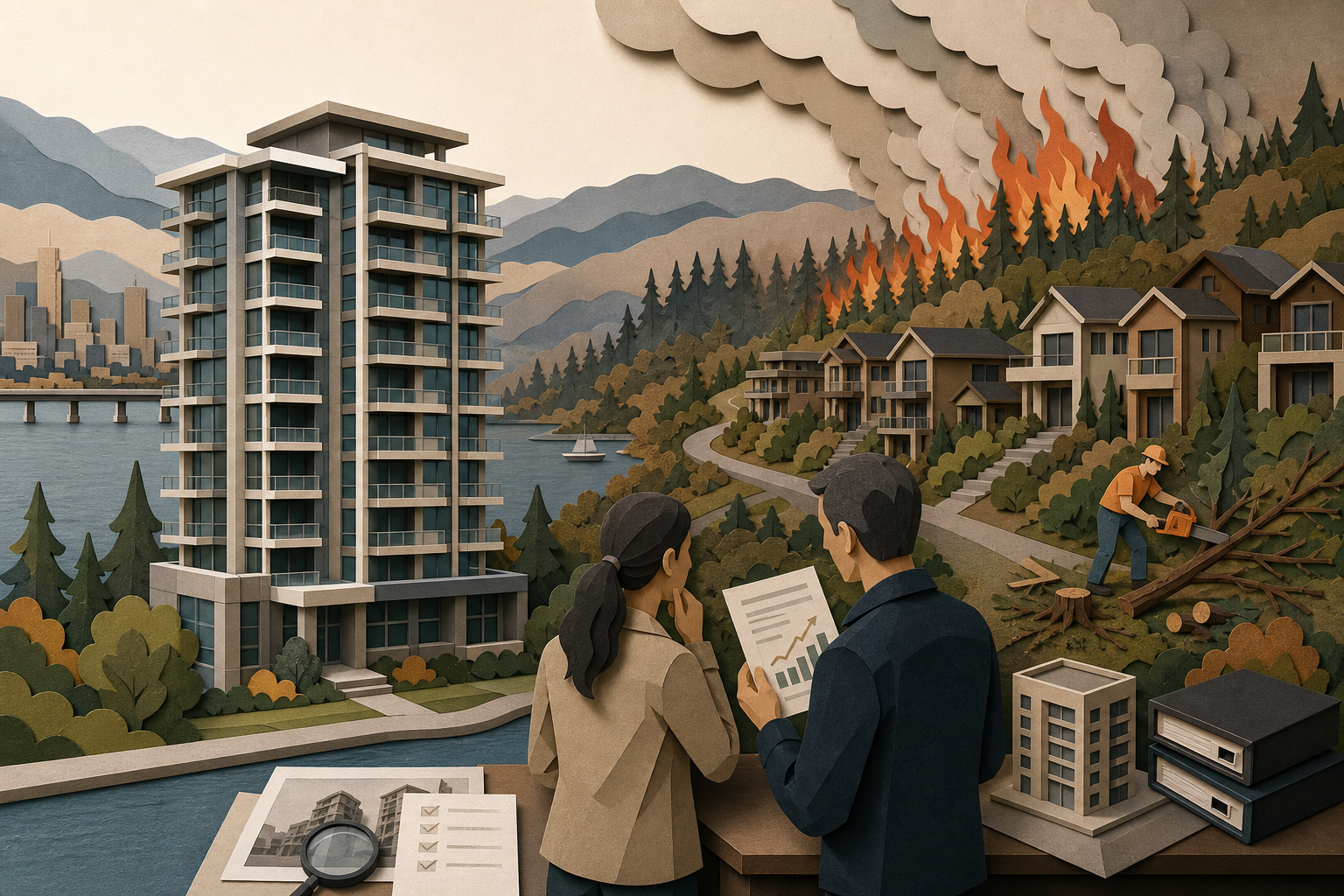

The strata insurance renewal came back 22% higher. Not because of claims, there hadn't been any. Because the building sits 1.8 kilometers from unmanaged forest fuel on the Upper Mission bench.
That's the version of wildfire risk most Kelowna condo buyers don't see until after closing. The rankings matter, but the insurance bill matters more. Here are the specific things you should check before you sign.
Insurance Is the First Casualty
Pull the strata's last three years of insurance renewals. Look for two things: the premium trend and the wildfire-specific deductible. Some Kelowna stratas now carry deductibles above $100,000 for total loss from wildfire. If your building's deductible jumped from $25,000 to $150,000 in the last renewal, that risk sits on the owners, not the insurer. Ask whether the strata has had to pass a special levy in the past 18 months to cover the gap between reserves and new insurance requirements. If they have, assume it will happen again.
Concrete and steel buildings in the downtown core have lower volatility. Wood-frame townhomes on Black Mountain or the benches above Okanagan Lake are seeing the steepest hikes. The difference isn't minor, it's structural.
Exterior Materials and HVAC Are Now Balance-Sheet Items
Walk the building perimeter. Vinyl siding and wood trim are liabilities in high-risk zones. Fiber cement, stucco, and metal cladding reduce ignitability and, more practically, reduce how much the insurer will charge to cover the building. Some buyers now bring a contractor on the pre-inspection walk specifically to assess exterior materials against FireSmart BC standards.
Inside, check the HVAC system. Buildings with central air handling that includes HEPA filtration and positive pressure hold value better during Kelowna's smoke weeks. The Okanagan now experiences prolonged stretches where PM2.5 levels make outdoor air unbreathable. A condo with 1980s baseboard heating and no central air is harder to sell when buyers are comparing units side-by-side during wildfire season. That gap shows up in days-on-market.
Proximity to Fuel-Managed Land Is a Pricing Variable
Check whether the public land adjacent to your building has had recent fuel reduction work. The City of Kelowna's Community Wildfire Resiliency Plan maps which areas have been thinned, which are scheduled, and which remain untreated. Buildings next to treated zones list it in MLS descriptions now, the same way lake views used to be the only geographic amenity that mattered.
Distance matters in absolute terms. A building 400 meters from the wildland-urban interface has a different risk profile than one 40 meters out. Pull the city's WUI map and measure. If the listing doesn't mention it, the seller either doesn't know or doesn't want you to know.
Reserve Fund Allocation Tells You What the Strata Knows
Read the depreciation report. Look at the line items for roofing, landscaping, and exterior envelope work. A strata that knows its risk has already budgeted for FireSmart upgrades, removing cedar shake roofs, clearing defensible space, replacing combustible decking. A strata that hasn't is either ignoring the risk or planning to special-levy the work when the insurer forces it.
The McDougall Creek fire in 2023 reset what insurers will tolerate. Buildings that looked fine on paper in 2022 now require six-figure upgrades to maintain coverage. If the reserve fund shows no FireSmart-related line items and the building was built before 2015, you're buying into deferred cost.
Kelowna's market hasn't collapsed, population growth is still strong, and buyers keep arriving. But the spread between low-risk and high-risk properties is widening. The #1 ranking is a data point. The insurance renewal is the bill.
Read Next
Personal Letters Still Win Toronto Homes When Everyone Else Assumes They Don't
25 States Sue Trump Over Tariffs, Testing the Outer Limits of Executive Trade Power
TD Securities: Markets Are Wrong About Fed Rate Holds, and the Dollar Will Pay
Carney's Alberta Housing Tour Met by Separatist Flags and Growing Regional Fracture